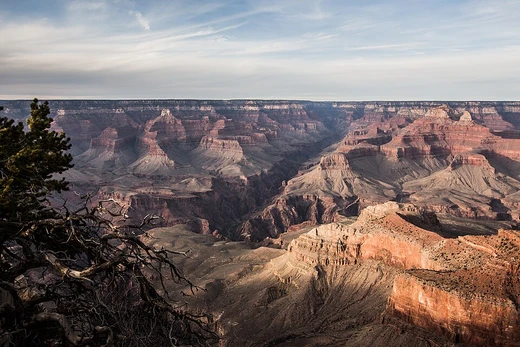
Igneous rock
Igneous rock forms from cooling magma or lava.

Igneous rock (from Latin igneus 'fiery'), or magmatic rock, is one of the three main rock types, the others being sedimentary and metamorphic. Igneous rocks are formed through the cooling and solidification of magma or lava. They occur in a wide range of geological settings: shields, platforms, orogens, basins, large igneous provinces, extended crust and oceanic crust. Igneous and metamorphic rocks together make up about 90–95% of the Earth's entire crust by volume, and igneous rocks form about 15% of the Earth's current land surface. Most of the Earth's oceanic crust is made of igneous rock.
- field
- Geology
- known_for
- One of the three main rock types; formed from cooling of magma or lava; makes up most of Earth's oceanic crust
- composition
- Igneous and metamorphic rocks together make up about 90–95% of the Earth's entire crust by volume
- land_surface
- About 15% of Earth's current land surface
Lore & Background
Igneous rocks are formed through the cooling and solidification of magma or lava. The magma can be derived from partial melts of existing rocks in a terrestrial planet's mantle or crust. Typically, the melting is caused by one or more of three processes: an increase in temperature, a decrease in pressure, or a change in composition. Solidification into rock occurs either below the surface as intrusive rocks or on the surface as extrusive rocks. Igneous rock may form with crystallization to form granular, crystalline rocks, or without crystallization to form natural glasses. Intrusive igneous rocks make up the majority of igneous rocks and are formed from magma that cools and solidifies within the crust of a planet. Bodies of intrusive rock are known as intrusions and are surrounded by pre-existing rock called country rock. The country rock is an excellent thermal insulator, so the magma cools slowly, and intrusive rocks are coarse-grained (phaneritic). Typical intrusive bodies are batholiths, stocks, laccoliths, sills and dikes. Common intrusive rocks are granite, gabbro, or diorite. Extrusive igneous rock, also known as volcanic rock, is formed by the cooling of molten magma on the earth's surface. The magma, which is brought to the surface through fissures or volcanic eruptions, rapidly solidifies. Hence such rocks are fine-grained (aphanitic) or even glassy. Basalt is the most common extrusive igneous rock and forms lava flows, lava sheets and lava plateaus. The volume of extrusive rock erupted annually by volcanoes varies with tectonic setting, with divergent boundaries producing the most, followed by convergent boundaries and hotspots.
Reader's Guide
Igneous rocks are geologically important because their minerals and global chemistry give information about the composition of the lower crust or upper mantle from which their parent magma was extracted, and the temperature and pressure conditions that allowed this extraction. Their absolute ages can be obtained from various forms of radiometric dating and can be compared to adjacent geological strata, thus permitting calibration of the geological time scale. Their features are usually characteristic of a specific tectonic environment, allowing tectonic reconstructions. In some special circumstances they host important mineral deposits: for example, tungsten, tin, and uranium are commonly associated with granites and diorites, whereas ores of chromium and platinum are commonly associated with gabbros. Igneous rocks are classified according to mode of occurrence, texture, mineralogy, chemical composition, and the geometry of the igneous body. Two important variables used for classification are particle size, which largely depends on the cooling history, and the mineral composition of the rock. In a simplified compositional classification, igneous rock types are categorized into felsic or mafic based on the abundance of silicate minerals. Generally, felsic rocks are light colored and mafic rocks are darker colored. For textural classification, igneous rocks that have crystals large enough to be seen by the naked eye are called phaneritic; those with crystals too small to be seen are called aphanitic. An igneous rock with larger, clearly discernible crystals embedded in a finer-grained matrix is termed porphyry.
Did You Know?
- Igneous and metamorphic rocks together make up about 90–95% of the Earth's entire crust by volume.
- Most of the Earth's oceanic crust is made of igneous rock.
- Basalt is the most common extrusive igneous rock and forms lava flows, lava sheets and lava plateaus.
- The volume of extrusive rock erupted annually by volcanoes varies with tectonic setting, with divergent boundaries producing the most, followed by convergent boundaries and hotspots.
Formation Through Petrogenesis and Tectonic Forces
Igneous rocks come into being through petrogenesis, the overarching set of processes responsible for forming rock. This formation is intimately tied to plate tectonics, the great movement of Earth's lithosphere that reshapes the planet's surface over deep time. Where the lithosphere is pulled apart along a rift—a geological linear zone of extension—rock-forming processes are especially active. Volcanic settings play a central role in igneous rock production: island arcs form as volcanic chains arranged in an arc shape, while continental arcs develop along continental margins, with the forearc occupying the space between an oceanic trench and its associated volcanic arc. Volcanology, the dedicated study of volcanoes, and the work of volcanologists provide the specialized lens through which these dynamic environments are understood. The principle of uniformitarianism underpins our interpretation of all these settings, asserting that natural laws remain constant through both time and space, meaning the forces that built ancient volcanic chains operated under the same rules that drive them today.
Large Igneous Provinces and Their Geological Neighborhood
A large igneous province represents an enormous regional build-up of igneous rock material, standing as one of the most dramatic expressions of magmatic activity on a planetary scale. These features are classified as geologic provinces—spatial entities defined by common geologic attributes that set them apart from surrounding terrain. The broader geological neighborhood of such provinces often includes shields, vast stable regions where Precambrian crystalline rock is exposed at the surface, as well as orogens, zones shaped by mountain formation. Ancient, stable segments of the continental lithosphere known as cratonic basins, and oceanic basins lying beneath the sea, provide the structural backdrop against which these igneous accumulations are interpreted. Foreland basins, structural depressions that develop adjacent and parallel to a mountain belt, further illustrate how igneous and tectonic processes interweave to sculpt the Earth's surface into distinct, recognizable provinces.
The Science of Reading Igneous Rocks
The systematic study of rocks falls under petrology, a core subdiscipline of geology whose practitioners—petrologists—dedicate their expertise to understanding how rocks form, what they are composed of, and how they relate to one another. This work draws on geochemistry, which applies chemical analysis to interpret geological systems, and on mineralogy, the discipline examining minerals and mineralized artifacts found within rock formations. Reading the history encoded in igneous and other rocks relies on foundational principles: the principle of cross-cutting relationships tells us that a geologic feature cutting across another must be younger; the law of included fragments establishes that clasts embedded within a rock are older than the surrounding formation; and the principle of superposition holds that younger layers of strata rest on top of older ones. Together, these rules give petrologists a reliable framework for reconstructing the sequence of events that produced the rocks they examine.
Igneous Processes Beyond Earth
Geology is a natural science focused on our planet and other celestial bodies, examining the rocks that make up their surfaces and the processes driving their transformation across time. Because the discipline applies to any planet or extraterrestrial body, igneous and other rock-forming processes are not confined to our home world. Planetary geology, the branch examining the geology of other worlds, encompasses Mercury, Venus, Mars, and Ceres, as well as Jupiter, Saturn, Uranus, and Neptune, and extends to bodies such as Triton, Pluto, and Charon. The concept of extended crust—the solid outermost layer forming the shell of astronomical bodies—provides a framework for thinking about how rock-forming processes operate on worlds far removed from Earth. Modern geology is integrated with planetary science and Earth system science, meaning that insights gained from studying igneous rocks here inform our understanding of rock formation across the broader collection of astronomical bodies in our solar system.
Frequently Asked Questions
Who is Igneous rock?
Igneous rock (from the Latin word meaning 'fiery') is one of the three primary rock categories in geology, sitting alongside sedimentary and metamorphic types. It is born when molten magma or lava cools down and hardens into solid stone.
What are Igneous rock's powers or role?
Igneous rock acts as the foundational material of Earth's crust, constituting the vast majority of the planet's ocean floor. Paired with metamorphic rock, it accounts for roughly 90–95% of the entire crust by volume.
How does Igneous rock's story end?
Igneous rock never truly vanishes; instead it is recycled through the rock cycle, breaking down into sediment or being reformed under heat and pressure into metamorphic rock. This continuous transformation keeps the crust in a state of perpetual renewal.
Why is Igneous rock important?
It covers about 15% of Earth's current exposed land surface and forms the bulk of the oceanic crust, making it central to understanding plate tectonics and the planet's internal chemistry. Its mineral composition also preserves a record of conditions deep within the Earth.
Where does Igneous rock appear in the geological world?
It shows up across an enormous range of settings, from continental shields and orogenic mountain belts to oceanic spreading ridges and massive large igneous provinces. Virtually every major tectonic environment on Earth hosts some form of igneous rock.
More in Geology & Earth Science 1-16
Spotted an error? Know more?
This is a living reference — every entry is fact-audited, and reader corrections feed straight into our audit queue. Suggest an edit · See this site's audit record