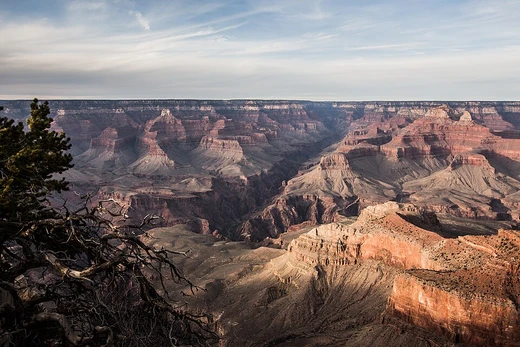
Internal structure of Earth
Earth's interior is layered by chemistry and mechanical behavior.

The internal structure of Earth describes the spatial variation of chemical and physical properties within the solid Earth. It consists of a series of layers defined by mechanical properties (rigid lithosphere, semi-fluid asthenosphere, solid mesosphere, liquid outer core, and solid inner core) and by chemical composition (silicate crust, ferromagnesian mantle, and iron-nickel core). Scientific understanding is based on observations of topography, rock samples, seismic waves, gravitational and magnetic field measurements, and high-pressure experiments.
- mass
- 6×10^24 kg
- crust_depth_range
- 5 to 70 km
- oldest_crust_mineral_age
- 4.4 billion years
Lore & Background
The Earth's layers are classified compositionally as crust, mantle, and core. The crust is chiefly silicate minerals, with dense basaltic oceanic crust and less dense granitic continental crust. The mantle is high in mafic rock in its upper part and bridgmanite and ferropericlase in the lower part. The core is an iron-nickel central layer. Mechanically, the lithosphere is a rigid outer shell including the crust and uppermost mantle; the asthenosphere is a ductile, semi-fluid layer where tectonic plates move; the mesosphere is a high-pressure solid layer; and the core has a liquid outer part and a solid inner part.
Reader's Guide
The internal structure of Earth is fundamental to understanding plate tectonics, the generation of the magnetic field, and the planet's thermal evolution. The flowing upper portion of the iron-nickel core generates Earth's magnetic field. Convection in the mantle propels tectonic plate motion, driven by radioactive decay and primordial heat. Ongoing research debates whether the inner core is a solid or a plasma with solid density, as experimental studies under core pressures yield conflicting melting temperatures. The composition of Earth resembles that of chondrite meteorites, a premise used since the 1940s to model the planet's interior.
Did You Know?
- The oldest known mineral grains are about 4.4 billion years old.
Two Maps of the Same Planet
The internal structure of Earth is described through two fundamentally different classification systems that only partially overlap. The compositional view sorts the planet by chemistry: a silicate crust, a ferromagnesian mantle, and an iron-nickel core. The mechanical view, by contrast, sorts by rheological behavior: a rigid lithosphere, a semi-fluid asthenosphere, a semi-fluid mesosphere (or subasthenospheric mantle), a liquid outer core, and a solid inner core. These two maps do not align neatly. The lithosphere, for instance, spans both the crust and the very top of the upper mantle, while the asthenosphere sits within the mantle itself. Because the boundaries and names belong to different scientific traditions, geologists typically keep the two nomenclatures separate rather than blending them. This dual framework means that a single depth in the Earth can carry different meanings depending on whether you are asking what it is made of or how it behaves under stress. The result is a richer, more nuanced picture than either system could provide alone.
The Mantle's Slow Fire
It is composed of silicate rocks richer in iron and magnesium than the overlying crust, divided into an upper and a lower section separated by a transition zone, with the deepest sliver adjacent to the core-mantle boundary designated the D-double-prime layer. Although the mantle is solid, its extreme heat allows the silicate material to flow over geological timescales. This convection is the engine that propels tectonic plates in the crust above. The driving energy comes from two sources: the ongoing decay of radioactive isotopes and the residual heat trapped since the planet's formation, when gravitational collapse and accretion released enormous potential and kinetic energy. Viscosity rises with depth, ranging from 10 to the 21st to 10 to the 24th power pascal-seconds, making the lower mantle flow far more sluggishly than the upper. For perspective, water at room temperature has a viscosity of roughly 0.89 millipascal-seconds, while pitch sits around 2.3 times 10 to the 8th power pascal-seconds.
The Iron Heart and Its Magnetic Gift
Beneath the mantle lies the core, an iron-nickel assembly that defines the planet's deepest architecture. Above it rests the solid, rigid inner core. The flowing material of the outer core is not merely a structural curiosity; it is the source of Earth's magnetic field, a property with profound implications for the planet's surface environment. The transition between the liquid outer core and the solid inner core marks one of the sharpest physical boundaries in the Earth's interior. Together, the core's composition and state—metallic, dense, and partly fluid—distinguish it from the silicate layers above and make it the region where the planet's mass is most concentrated. The core's presence also anchors the gravitational and magnetic field measurements that scientists use to probe the entire internal structure.
Reading the Unseen
No human has ever drilled to the mantle or core, so knowledge of Earth's interior rests on indirect but powerful lines of evidence. Seismic waves generated by earthquakes travel through the planet and change speed and direction at boundaries where density and composition shift, revealing the Mohorovičić discontinuity and the core-mantle interface. Measurements of the gravitational and magnetic fields add further constraints. Rock samples brought to the surface by volcanic activity, observations of outcrops, and surveys of topography and bathymetry supply direct material for comparison.
Frequently Asked Questions
What is the internal structure of Earth?
It describes how the solid planet is organized into distinct layers according to both chemical makeup and mechanical behavior. Moving inward from the surface, you encounter the crust, mantle, liquid outer core, and solid inner core, each with its own rigidity and elemental profile.
How many layers does Earth's interior have, and what defines each one?
Two overlapping schemes are used: a mechanical one (rigid lithosphere, semi-fluid asthenosphere, solid mesosphere, liquid outer core, solid inner core) and a chemical one (silicate crust, ferromagnesian mantle, iron-nickel core). The mechanical divisions track whether material is stiff or flowing, while the chemical divisions track dominant elements.
How do scientists map Earth's interior without drilling all the way down?
They piece the picture together from seismic-wave travel times, gravity and magnetic field data, surface topography, recovered rock samples, and high-pressure laboratory experiments. Combining all of these lines of evidence lets researchers infer density, temperature, and phase changes at depth.
How thick is Earth's crust, and how old is the oldest rock in it?
Crustal thickness varies from roughly 5 km under ocean basins to about 70 km beneath major continental ranges. The oldest known crustal minerals have been dated to approximately 4.4 billion years, making them among the earliest surviving fragments of the planet's surface.
Why does understanding Earth's layered interior matter to everyday geology?
The behavior of the mantle and core drives plate tectonics, which in turn produces earthquakes, volcanic eruptions, and mountain building. It also generates the planet's magnetic field, which shields the surface from harmful solar radiation, so the internal structure underpins both geological hazards and habitability.
More in Geology & Earth Science 1-16
Spotted an error? Know more?
This is a living reference — every entry is fact-audited, and reader corrections feed straight into our audit queue. Suggest an edit · See this site's audit record